Mr. Dhakal is the most experienced participant in this study; he has been working as a senior science teacher at one of the top schools for thirty years. His kindly nature influenced me so highly that I immediately fell for his in-depth perceptions. Normally, we used to communicate for the special task purpose as he is guiding the Science Teachers’ Association Nepal-STAN in Gandaki province, and also an eighth-month research colleague for the Tata Institute of Social Science-TISS. We rarely discussed our past experiences related to our profession and schooling, but when I increased my rate of communication after being informed about this research, I slowly began to gain a unique perspective, understanding the challenges and practices in science education. As he is working as the leader of STAN, Gandaki Province, he has more than enough friends in his circle for strengthening the profession; therefore, he could reflect a large scale of teaching practices on behalf of hundreds of active science teachers. I followed him for long days, and due to the inconvenient time availability, we were unable to meet, but one day, when I was returning from the university, I got a chance to visit his school.
Mr. Sunar is a dynamic and active science teacher with a charming voice and extensive experience. He is of Nepali origin but spent much of his life in India, where he completed his education at an army school and later earned a Bachelor’s degree in science from Nehru Education in Shillong, Meghalaya State. In 2007, he returned to Pokhara and began his teaching career. He chose not to go abroad as he needed to care for his mother. After several years of experience in different schools, he has been teaching science at GBS at the secondary level for ten years. Similarly, Mr. N. Dhakal is a kind and active science teacher with a soft voice and extensive experience. He grew up in a remote area of western Nepal, in the Rukum district of Karnali province, where he faced many challenges during his schooling at a community-based school. He completed his I Sc. and BSc. degrees at Amrit Campus in Kathmandu and has been teaching for twenty years.Three Different Backgrounds of Teachers
[To begin with, I put a query concerning their school background about their cultures of science learning, and to what extent they experienced the hands-on activities connected to the real world.]
Mr. Dhakal: “During my school days, science subjects were optional, and there were only four students in the class. Due to an extreme lack of science teachers, we struggled hard to achieve science education. I remember an unforgettable incident with my Indian science teacher in ninth grade. The topic was Susmadarsak yantra (microscope) and Durdarsak yantra (telescope) under the optical instrument chapter. Due to the unavailability of a blackboard, chalk, and copies, my teacher could not draw a ray diagram of a microscope and a telescope. He simply delivered the definition and application of that instrument. I rote-memorized the definitions and applications of them. Once, I asked my Indian science teacher whether we could observe a louse the size of an elephant from the microscope. I don’t know whether he responded normally or by scolding me, but he replied yes! If we observe you through a microscope, then we can see you as your father. Later, I topped the SLC board exam from the Syangja district, and thus I was motivated to join I.Sc.
Mr. Sunar said, “I schooled in an Army school following the CBSE curriculum in Shillong, India, and there used to be a weekly routine for science-related projects, either in laboratory experimentation or for home-assigned projects. I experienced science learning with theoretical and practical engagements simultaneously. My teachers often emphasized active participation in an interaction where I was driven by the mindset of deeper understanding from an authentic inquiry-based approach.”
Mr. N. Dhakal said, “I was schooled at a government school in a remote area of Rukum, Nepal. In my time, science subjects were introduced only after class four. There used to be simple, real-life-based observatory engagements; otherwise, my science learning was mostly lecture-based and rote memorization. In addition, after the sixth class, my new science teacher was newly appointed in the school, actually from a Sanskrit background, and his teaching approach was completely lecture-based. I still remember the event in eighth class when the district administration donated a microscope to the school with several slides. Even after several attempts, we didn’t observe the cell, and at last, my science teacher claimed the fault was in the microscope. At that time, we were so disappointed with that microscope, and now I assume that it might be because my teacher was not aware of the mirror configuration for light enrichment to the slide. I added that project-based science learning was far from expected; we struggled hard to pass exams and score good marks in science through rote memorization.”
[I was depressed about the scenario of Mr. Dhakal & Mr. N. Dhakal and moved ahead, inquiring about how often they experienced authenticity, collaboration, reflection, and critical discussion and assessment during the project. Here, Mr. Dhakal and Mr. N. Dhakal did not share as they had not experienced them enough as shareable during their school time.]
Mr. Sunar said, “Yes, I experienced enough collaboration and peer-based projects; most of the projects were aligned with the curriculum, real-life problem-solving, and learner-focused, which means we were empowered to complete them. I still remember some of the projects from tenth standard, such as exploring the nutritional profile of soybean oil and experimenting with the effectiveness of antibiotics, among others. My science teachers used to probe multiple questions concerning the process and outcomes of every project, as we had to reflect on our project with scientific reports in our reporting worksheets, and according to that, evaluation used to be done, but I remember a few peer collaborations and evaluations, as most of the projects were individually completed.”
[Immediately, I probed a query to know what Mr. Sunar thinks about the development of 21st-century skills from those projects.]
Mr. Sunar: “At that time, I was not aware of 21st-century skills, but referencing the present context, I think the attitude of interaction during the learning process, communication skills, creative and problem-solving skills, and design thinking were some of the skills that I developed while doing projects at my school age. I added that, from early grade, my teachers used to encourage all to speak and raise questions and assign creative work like drawings, designing, and model making.”
Mr. Dhakal and Mr. N. Dhakal faced challenges in learning science due to a lack of resources and qualified teachers. Their science education was based on lectures and memorization, which is a conventional approach (Yeo & Nielsen, 2020) that reflects the conventional learning culture. In contrast, Mr. Sunar had a positive experience with science education in an Army school in India, where he learned science through weekly projects that were aligned with the curriculum and focused on real-life problem-solving. His science education followed an inquiry-based learning approach, which is a dynamic and student-focused teaching method (Kokotsaki et al., 2016). Mr. Sunar developed skills such as communication, creativity, and problem-solving through doing projects. His teachers also encouraged art-based teaching, which is important for fostering innovation and design thinking (Halverson & Sawyer, 2022).
Common Culture of the Three Teachers: Well-structured
[Knowing the saturated information of past experiences was recalled, I switched my queries to teaching practices. At the very first, I inquired about their teaching methodology and how often and what kinds of projects they incorporate regularly.
All teachers reported that they share a common approach to assigning and implementing projects, which involves following a weekly science worksheet. This worksheet contains content and curriculum-based activities for both in/out-lab and at-home learning. These activities are designed to foster cognitive, communicative, and hands-on skills in students.] In addition,
Mr. N. Dhakal: “I promote the use of local, low-cost, and no-cost teaching materials for projects, such as using old pens to make syringes or using glue guns to create models of levers.”
Mr. Sunar: “I shared an example of an in-class activity where students observed the effects of different voltages on a fan and classified the dependent, independent, and controlled variables.”
Mr. Dhakal: “We have to make a terminal and a yearly plan for our subject, including chapter-wise learning objectives and supporting teaching methodology. For activity-based classes, we have to follow the weekly activity workbook, which is prepared by ourselves aligning with the ongoing curriculum. Moreover, I advocate for more engagement of students in the teaching and learning process beyond their practical workbook.”
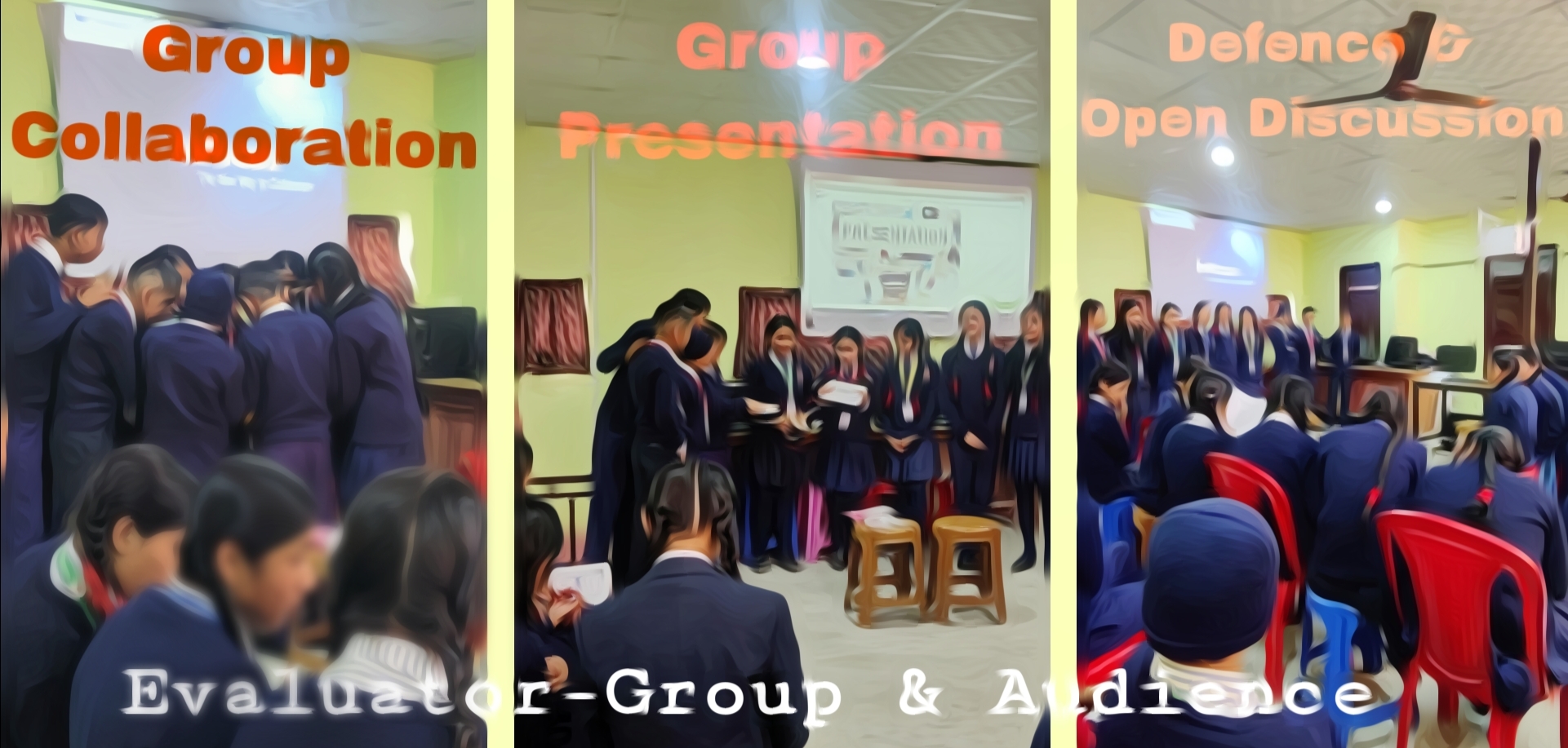
[All teachers stated that their students and school management are supportive of hands-on activities and that at least one activity is planned for each topic. They also have access to laboratory assistants who help set up experiments and provide supervision during activities. Therefore, they claimed that they were good and covered the maximum criteria for formative assessment.]


Result and Discussion
Though they have diverse backgrounds in learning science, currently they are embracing the common culture of implementing project-based learning in secondary-level science education. They developed the common teaching practice following the same worksheets, and their culture of implementation can be highlighted as follows:
Teaching Materials, Assignments, and Teaching Strategies: The teachers use low-cost and local materials for projects, which can enhance students' creativity and engagement (Sivakumar, 2015). They assign both individual and group projects, which can foster collaboration and communication skills among students. They follow an inquiry-based learning approach, which is a dynamic and student-focused teaching method that emphasizes active participation and problem-solving (Kokotsaki et al., 2016) and art-based teaching, which is important for fostering innovation and design thinking (Halverson & Sawyer, 2022). Moreover, they enable students to explore the content through hands-on activities, which can deepen their understanding and retention of the concepts (Kolb, 1984).
Project Categorization: The teachers categorize their projects based on the content and curriculum objectives, as well as the level of difficulty and complexity. They plan at least one activity for each topic, and claim that they practice highly activity-based science classes. Their hands-on activities are mostly content-based and activity-based, with fewer contextual and real-life problem-based projects. They assign both individual and group-based activities for common objectives.
Student Space and Collaboration: The teachers adopt a liberationist approach to PBL, which considers knowledge to be of utmost importance and guides learners to contribute towards positive change (Tsanyane, 2023). The teachers facilitate the development of well-rounded, knowledgeable, and ethical individuals by fostering an open-minded learning environment. They address students' space by allowing them to design and construct the process independently, with a focus on content understanding and reflection. They initiate the project and actively observe students' activities for assessment using rubrics, with the assistance of laboratory helpers. They focus on developing skills such as ICT, critical reflection, collaboration, communication, foresight thinking, and risk assessment, and track student progress through portfolios and workbooks, which are key characteristics of the project-based teaching and learning process (Markula & Aksela, 2021).
Challenges and Solutions: The teachers face some challenges in implementing PBL, such as time constraints, lack of resources, criticism from guardians, and alignment with the term plan. They overcome these challenges by using low-cost or no-cost materials, designing home-based projects, accessing assistant teachers and laboratory helpers, and going beyond the workbook to cover the curriculum.
Evaluation: The teachers evaluate students' performance through practical exams, portfolios, workbooks, and rubrics. They do not practice peer evaluation or critical questioning, which are important aspects of PBL that can promote self-regulation and metacognition among students (Markula & Aksela, 2021). Additionally, they are positive about the existing curriculum, which is more aligned with their practices than the previous one, which was more content-specific and encouraged rote memorization.
Acknowledgement
I express my heartfelt gratitude to the participating teachers and their dear students for their commendable dedication and commitment to fostering an enriching learning environment. Their passion for teaching and ability to bring out the best in their students is truly inspiring. Their invaluable insights and experiences have been instrumental in this endeavor.
References
Halverson, E., & Sawyer, K. (2022). Learning in and through the arts. Journal of the Learning Sciences, 31(1), 1-13. https://doi.org/10.1080/10508406.2022.2029127
Kokotsaki, D., Menzies, V., & Wiggins, A. (2016). Project-based Learning: A review of the literature. Improving Schools, 19(3), 267-277. DOI:10.1177/1365480216659733
Markula, A., & Aksela, M. (2022). The key characteristics of project-based learning: how teachers implement projects in K-12 science education. Disciplinary and Interdisciplinary Science Education Research, 4(2). https://doi.org/10.1186/s43031-021-00042-x
Sivakumar, R. (2015). Impact of low-cost teaching aids in teaching science. Innovative Thoughts International Research Journal, 2(3). Researchgate.net
Fenstermacher, G. D., & Soltis, J. F. (2009). Approaches to Teaching. In J. F. Soltis (Ed.), Approaches to Teaching (4th ed., pp. 1-10). Teachers College Press.
Yeo, J. & Nielsen, W. (2020). Multimodal science teaching and learning, Learning: Research and Practice, 6:1, 1-4. https://doi.org/10.1080/23735082.2020.1752043
Cite this article:
Limbu, S. (2023). Exploring the Culture of Practicing Project-based Learning by In-service Science Teachers: An Ethnographic Inquiry [MPhil dissertation, Kathmandu University].